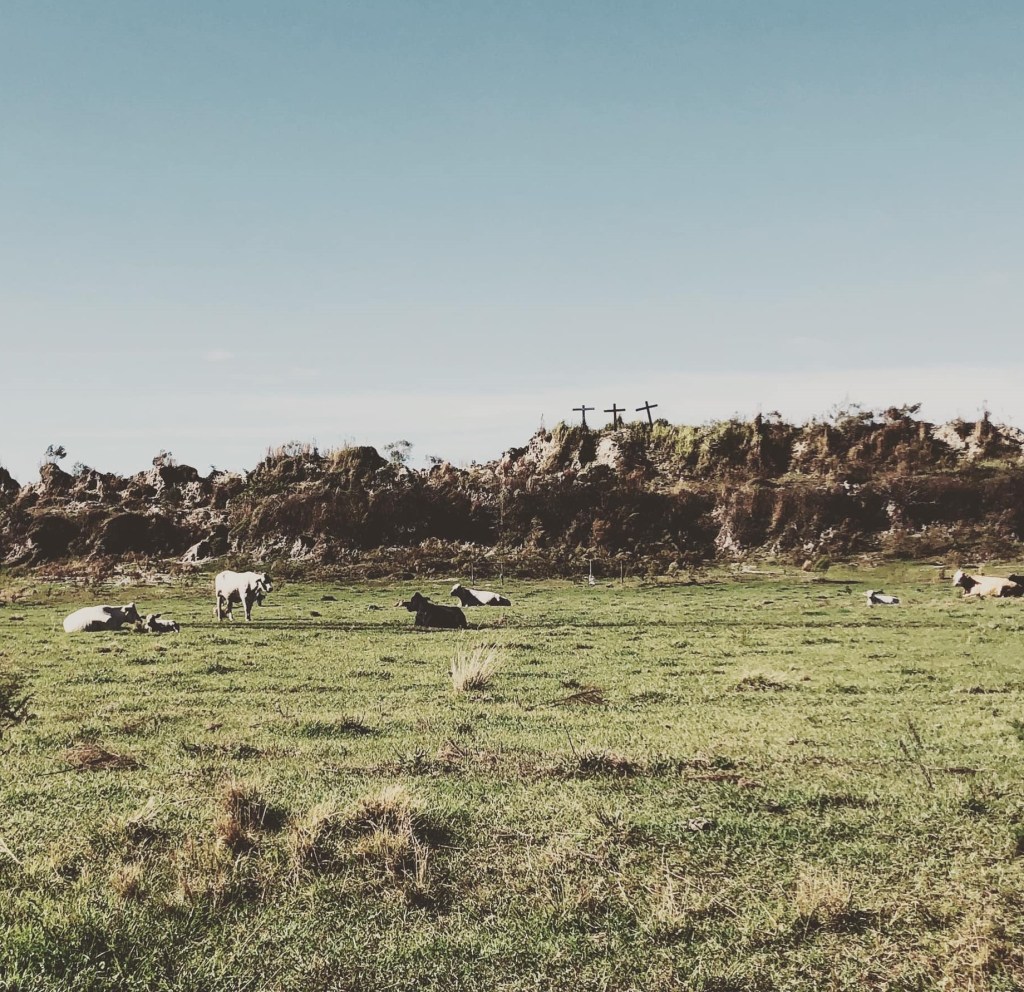
“I watched a wake of turkey vultures slurp up bits of cow…”
The Scavenger, a rural Florida gothic serial killer tale, first dramatized by Creepy Podcast and later picked up by Illustrated Worlds Magazine – is reprinted below.
(First, though, this photo…taken from my grandparent’s 40 acre homestead in Arcadia, FL, where this story is set. Crazy place!)
The Scavenger
I watched a wake of turkey vultures slurp up bits of cow. Unfeathered, ballsack looking heads dipped up and down into the carcass buffet, ripping off meat in dripping, sinewy strings. Bloody beaks gleamed wet-hot-red under a disinterested Florida sun.
I will paint their portrait. Abstract expressionist, I think. Thick black lines like Franz Kline. I will sketch their withered faces. I will sculpt and mold the heads in plastic and screw them on top of comically large bodies wearing ballooning cloaks made of dark feathers, with wingspans longer than a man’s height. You will not believe it when the piece is unveiled. You will laugh. And then, while you laugh, I will lift a bucket and douse them in blood. You will be horrified. You will run me out of town.
Scavengers: I am reverent. Certain Indigenous cultures regard them as birds of peace, because they will not kill to live. Just what is it about that behavior that people with skin like mine find so disgusting?
I chugged up my truck and they all raised their heads to look at me: The Intruder. But they had no reason to fear me. I’ve got no stomach for sunbaked meat. Not this early in the day. I watched them grow small in my rearview mirror until I lost them completely.
#
Arcadia, Florida. A nothing place with a beautiful name, this was my home. Ten years ago, I had given art school a try. Less than a year in, I quit for my family’s homestead out here in the sticks and I never looked back. I traded Betye Saar’s watermelons for fields of the real thing. Damien Hirst’s farm animals, floating dead in clinical turquoise tubs, were all here, alive. Daily, I watched them, enjoying their peaceful naivety, freely grazing against a living blue sky – the kind of sky that made it easy to believe in a heaven above it. This, I thought, was true romance. The pastoral. The stuff of Constable and Millet. Not that of interesting-looking people in paint-stained designer jeans, their vapid minds consumed with shallow tragedies. The art “scene” was just that. A scene, a fabrication. Like all false things, it was aloof. Kept its distance for fear of being found out. Became one with its mask. The country, and that of south central Florida especially, invited you to experience wonder. And there were times – like when the sunset struck you blind with its impossible fuschia, when a field of saw palmetto flicked on and off under a quickly passing cloud, when a hurricane decided to spare you, turning toward the Gulf at the very last minute – there were times when Florida just dared you not to.
Cities fancied themselves cruel, with their blaring, their destitute, their unrepentant white collar criminals, their date rape party drugs. But those were selfish cruelties, which, to me, were the most uninteresting kind. Out here, cruelty was honest. It was tear-the-meat-from-your-bones. It was a cruelty to which we’d all agreed – the cruelty of an ecosystem, functioning in harmony.
In the ways it really mattered, a city was kind. For example, in a city a family could properly mourn their dead. A murdered body, generally speaking, would be quickly found, its decay winding through shared ventilation systems, or simply left in the street where it fell. Killers were more easily caught. It was simply a matter of a well-funded police force having access to resources and technology. But out here, in this forgotten place where everyone kept to themselves, where even the poor could possess acres of private land, mucked with entombing swamps and alligators, it was easy to keep secrets if you wanted something kept. If I am certain of anything I am certain of this: in comparison to the country, the city is kind. There is nothing more cruel than an empty casket funeral. Trust me.
#
I drove the mile-long shell gravel path from my homestead to the main road and hung a left, toward what City Hall called “the historic district,” a corridor defined by dying Victorian homes and unpaved side streets hiding family-owned cafes and dusty antique shops that always seemed to be going out of business, but never did. It was haunted, the entire lot of it, people said. I thought the people might be right.
Just past the old downtown was the real downtown, the downtown I was embarrassed to frequent, the one with the Dollar General, the Wal-Mart, the feed store, the KFC. The one with the stoplight where old Soonie sold fish wrapped in newsprint and loose cans of Michelob. What the hell, I thought. I called him over and he ran me a beer. I had it open before the light turned green and had sucked it all down before I hit the next red. I threw the can in the back with the rest.
I arrived at the boat dock and started scavenging. After that I walked to the public park. Only after that did I hit the roadsides. Before two o’clock I had two big trash bags of aluminum cans and an old muffler ready to take to Bill’s Scrap. It wouldn’t amount to much but not much was all I needed. Enough to buy some beans for lunch, maybe a jug of milk, and then the rest of the day was mine. I’ve always valued time over creature comforts.
On my way home, the residents of the old Miakka Cemetery whispered hello from underneath hundred year-old craggy, mossy oaks. I didn’t like that place, but I couldn’t avoid it unless I took the long way, and I couldn’t afford the gas.
When I was small, the adjoining church held Easter picnics complete with egg hunts for the kids. On my first hunt, I wandered to the graveyard. Perhaps they’d hidden some among the dead. I figured the chance of that was slim, but that didn’t stop me from looking. That was the day I discovered why the gravesites always looked so nice. All the flowers, every single one, were plastic. I thought that was cheating. Who were these lazy mourners living amongst me? I hated it with an intensity I could not yet understand.
#
I quit art school the day a student, some trust fund piece of shit, tacked a piece of blank notebook paper to the wall. Everyone was silent until I spoke up and said “this is a fallacious pathetic fallacy.” The student, unfamiliar with these words, heard “fellatio” and “phallus” and agreed with me. He would have agreed with anything. This was a drowning man.
Salvation came swiftly as his fellow students mused on how his blank piece of paper might symbolize the emptiness of casual sex. How a one-night stand is, so very frequently, nothing to “write home about” – an empty page in the book of life. The fact it was a single sheet, torn from a notebook of many, was a symbol of the shame of feeling “loose,” of finding oneself alone in the bed linens the next morning. I couldn’t believe how quickly his misunderstanding had morphed into metaphor. I was a passenger on a runaway train full of fools. I had never felt so alone in my entire life. That evening, I was on the first plane back to Florida. All of my things, presumably, were summarily forwarded to Chicagoland’s Livingston landfill.
With time I learned to value the experience, even though it was not what I’d hoped. At art school, every day, with the depths of humanity’s capacity for bullshit unapologetically on full display, I began to realize just how important authenticity was to me. How deeply I craved it. How piercing was my desire to rip open and crawl inside every single thing in this world that breathed life – be it animal, plant, or some enduring philosophical truth – and fuck its beating heart.
#
By the time I pulled back into the drive, the cow had been picked clean of its sinew, eyeballs, and organs. I couldn’t help myself – I took my eyes off the road to stare at its gaping cavity and the next thing I knew, the right side of my truck was angled down in the drainage ditch, the tires stuck in slime-green muck.
I got out and walked the rest of the way. No use crying over spilled milk, and anyway, I liked the walk up my private drive. It gave me a chance to spend some quality time with my flowerbeds. So many days I had just driven straight home, eager for my AC, or only gone out at dusk to do a quick weeding. When you live hand to mouth, I suppose, hobbies inevitably fall by the wayside.
I had seeded each bed with a different type of flower, one that I felt best represented the corpse lying underneath. All of this, what I do, had begun with a scavenge – a hitchhiker I’d found face down in a ditch just outside the town of Pine Level. She had been, I could tell, beautiful. In honor of her blond hair, a lock of which I washed and kept, I planted sunflowers.
After that, things in my life just started dying. When my old dog Rothko, my best friend, who I’d found in a Goodwill parking lot, died, I planted forget-me-nots. For my mother, weeds. Invasive. Something she could choke on.
Once there was nothing else close to me to bury, I started thinking maybe I could just find some things and help them along. My first was a plump little kid I found sleeping in the back of his mom’s truck outside the Riverfolk Honky-Tonk. For him I chose fat white dahlias. Like a child, they needed careful nurturing to grow.
There were six flowerbeds now, with space for dozens more. I thought about the cow and became agitated. I realized I’d need to figure out my truck and move the carcass over here before it started attracting coyotes. Queen Anne’s lace would be nice. I could plant those to the left of the Amish pie shop salesgirl’s goldenrods. A dairy cow next to a baker made the most sense. It was crucial that everything here made sense.
I ran for my shovel.
 Kelli Dianne Rule: Author
Leave a comment